Sunday 26th May 2013
My annual two-week holiday in Scotland started in the historic city of Stirling and in order to gradually get myself into the groove for the fortnight I began with some easier walking nearby. After a wonderful evening spent in glorious weather exploring the castle and the nearby Wallace Monument, I awoke to a more overcast day with the good weather of the previous day a distant memory. Not far from Stirling is a range of hills called the Ochil Hills whose most striking feature is in the deep ravines on the southern edge of the escarpment that lead down to a string of towns at the foot of the hills sited to take advantage of water-power from the fast moving burns. First thing in the morning I caught a bus to one of these towns, Tillicoultry, where I walked up into the Ochil Hills through the ravine of Mill Glen, a name that gives a hint of the area's industrial past. Unfortunately, when I got to the start of the path through the glen, I found that it had been closed due to the danger of rockfall.
This was a disappointing start to the walk as I’m sure the ravine would have been exactly the sort of place that I love to walk. Undeterred I took the diversion that climbs the hillside overlooking the town and the wider Forth Valley before contouring around the side of the hill high above the glen. This may not have been my intended route, but it was an excellent path that zigzags cleverly up the southern slope of the hill and later clings precipitously above the glen affording me with tremendous views into the deep, murky ravine before eventually dropping down a series of steps into the valley and joining the closed footpath. After crossing the burn I climbed the steep, grassy hill opposite up to the top of the hills where my interest in the walk diminished. The best bits of this walk were in the ravines while the actual tops were relatively dull as the path continued up the grassy hillside to the slender top of the Law where I found myself in the clouds.
It was quite cold and miserable at the top and the terrain didn’t improve as the narrow ridge opened out and gradually led me up easy slopes to the top of Ben Cleuch, the highest point in the Ochil Hills and classified as a Graham in the vast array of Scottish hill lists. The Ochil Hills are mainly just an undulating range of grassy hills with no significant peaks in them. I could have traipsed across all of the hills, through many bogs, bagging each and every top above two thousand feet, but it wasn’t the weather for such an endeavour and I really couldn’t be bothered. I continued along the top of the hill and gradually descended grassy slopes and turning towards the south and the col at the top of Millglen Burn. Passing over the top of Ben Ever I joined a track that descends steeply to the col between the Glenwinniel Burn and the Silver Burn. The low hill ahead of me at this point is marked as a viewpoint on maps so I climbed the short slope up to the top of the Nebit where I had my lunch while gazing across the wide Forth Valley.
After eating I came down from the top of the Nebit but on reaching a track I turned right and followed it round the lower slopes of the hill and back up into the hills high above the Alva Burn. It wasn’t my intention to climb back up into the hills, but to descend into Alva Glen where I hoped to discover the delights that this ravine would reveal, but this is such a deep glen it wasn’t until the Strabanster Burn joins the Alva Burn that I was finally able to safely get down the steep slopes from the track to the bottom of the valley. There I found a faint path beside the burn that eventually improved fabulously and stays safely above the spectacularly narrow ravine before steeply descending many zigzags, where an abundant array of wild flowers delightfully graced the hillside, into the glen for an exciting walk through the gorge. This path was just getting better and better from its meagre beginnings to the heavily constructed boardwalks that clung to the rocks at the bottom of the ravine. Alva Glen more than made up for my disappointment in missing out on Mill Glen as this glen was full of so many wild flowers I was enthralled and excited at every turn of the path until eventually it led me down into the town of Alva.
On reaching the outskirts of Alva I found a path that led me into the Ochil Hills Woodland Park, but this was a little disappointing after the excitement of Alva Glen. It was a nice wood really, especially since it was full of bluebells, but it couldn’t compete with the abundance of wild flowers in the glen. Tillicoultry lay a short distance beyond the wood and brought to a close a walk that was surprisingly much better than I had anticipated. I had thought this walk was going to be very short, but by diverting to Alva Glen I not only managed to extend the walk but passed through a fantastic glen that was easily the highlight of the day, if not the whole holiday. Before catching a bus back to Stirling I investigated the damage to the path in Mill Glen, climbing around the barrier that had closed off the path (at my own risk, of course). I found that large boulders had fallen onto the path in several places not only blocking the path but damaging the metal handrail that guards against falls into the deep ravine. I could easily see why the path had been closed and actually decided to turn back myself because the path was too damaged. This is a great pity as what I saw would have made for an exciting walk, but maybe not as good as that through Alva Glen. I look forward to returning when the path has been repaired and maybe exploring some of the other glens in the area as they are definitely the jewels in the Ochil Hills.
This is a blog of my many walks around Britain and Ireland, usually published weekly
Thursday, 20 June 2013
Thursday, 13 June 2013
Knott Rigg
Saturday 6th April 2013
Before describing my recent holiday in Scotland I have one day left of my holiday at Easter in the Lake District. This was a short walk because of the need to get to Penrith railway station by three o’clock, and consequently Keswick bus station by quarter past one. This is not the first time I’ve had this sort of problem from Buttermere. Just after spending the New Year in 2010 in Buttermere I also had to quickly get back to Keswick, so I had walked up to Newlands Hause and over Knott Rigg and Ard Crags. I thought I’d do something similar this time because, despite being a quick route into the Newlands Valley, it still involves going to the top of a hill, unlike other routes nearby. In 2010, due to the severity of the snow at that time, the Newlands pass was completely blocked to traffic which left me with a wonderful, undisturbed walk to the top of the pass. This time I did not have that benefit so I turned off the road as soon as possible onto the grassy slopes above Sail Beck and below the road.
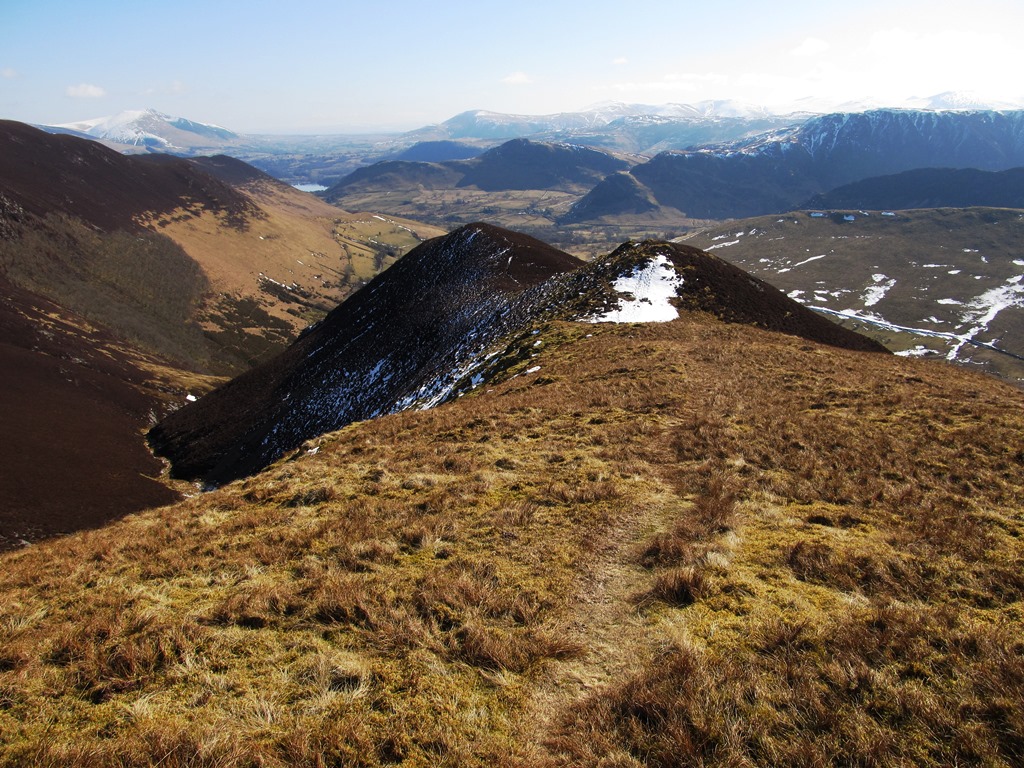
This path is not marked on maps but is clear on the ground up to Swinside Gill where, after crossing the stream, Knott Rigg can be climbed direct up a steep grassy slope. This is still not a very good route up and is no better than the usual route from the top of the pass. The weather, though, was ample compensation as there was hardly a cloud in the sky throughout the walk up to the long ridge that lies along the top of the fell and provided me with a pleasurable stroll to the summit. In 2010 I had continued along the ridge to Ard Crags but now in order to explore a different path I veered right onto a side ridge that gradually descends on a gloriously narrowing path all the way down to Keskadale Farm. My onward route was now across farmland, but I’m not too keen on walking through farmland, because since it’s not access land you have to be careful to follow a footpath that is often hard to find and poorly marked. I always feel as if I’m intruding on someone’s workplace, which in fact I am, and on occasions I have found waterlogged fields and loads of sheep or cows.
With the northern ridges of Robinson and Hindscarth dominating my view I finally joined the farmer's track from Low High Snab that I had taken two years ago when also walking back to Keswick from Buttermere. On that occasion I’d had more time and used it to climb Robinson via Hassnesshow Beck before descending over High Snab Bank. With the farmland behind me I now had a lovely stroll through the beautiful Newlands Valley in gorgeous weather to the western banks of Cat Bells on a now familiar path that took me to an even more familiar path through Fawe Park and Portinscale to Keswick. The weather for this walk continued to be good as it had for most the week. It never rained all week, which is not something that can usually be said of the Lake District and I always had a view from the top of every fell that I climbed. Considering this I really shouldn’t complain about the weather.
But I’m British so I will! It was very cold and there was a lot of winter snow still on the high fells which kept me off the very fells that I’d come to the Lake District to climb. I can’t help but be disappointed and frustrated by this holiday despite being in the Lake District in gorgeous weather when the fells are looking particularly picturesque. On the high fells there was a strong, very cold easterly wind that acted as a deterrent to anyone trying to venture up high despite the snow, but in the valleys it has been fantastic, like a warm spring day. The valleys may have been better than being at the top of the fells, but the tops are where my heart yearns to be. I’m sure it won’t be too long before that is where I am.
Before describing my recent holiday in Scotland I have one day left of my holiday at Easter in the Lake District. This was a short walk because of the need to get to Penrith railway station by three o’clock, and consequently Keswick bus station by quarter past one. This is not the first time I’ve had this sort of problem from Buttermere. Just after spending the New Year in 2010 in Buttermere I also had to quickly get back to Keswick, so I had walked up to Newlands Hause and over Knott Rigg and Ard Crags. I thought I’d do something similar this time because, despite being a quick route into the Newlands Valley, it still involves going to the top of a hill, unlike other routes nearby. In 2010, due to the severity of the snow at that time, the Newlands pass was completely blocked to traffic which left me with a wonderful, undisturbed walk to the top of the pass. This time I did not have that benefit so I turned off the road as soon as possible onto the grassy slopes above Sail Beck and below the road.
This path is not marked on maps but is clear on the ground up to Swinside Gill where, after crossing the stream, Knott Rigg can be climbed direct up a steep grassy slope. This is still not a very good route up and is no better than the usual route from the top of the pass. The weather, though, was ample compensation as there was hardly a cloud in the sky throughout the walk up to the long ridge that lies along the top of the fell and provided me with a pleasurable stroll to the summit. In 2010 I had continued along the ridge to Ard Crags but now in order to explore a different path I veered right onto a side ridge that gradually descends on a gloriously narrowing path all the way down to Keskadale Farm. My onward route was now across farmland, but I’m not too keen on walking through farmland, because since it’s not access land you have to be careful to follow a footpath that is often hard to find and poorly marked. I always feel as if I’m intruding on someone’s workplace, which in fact I am, and on occasions I have found waterlogged fields and loads of sheep or cows.
With the northern ridges of Robinson and Hindscarth dominating my view I finally joined the farmer's track from Low High Snab that I had taken two years ago when also walking back to Keswick from Buttermere. On that occasion I’d had more time and used it to climb Robinson via Hassnesshow Beck before descending over High Snab Bank. With the farmland behind me I now had a lovely stroll through the beautiful Newlands Valley in gorgeous weather to the western banks of Cat Bells on a now familiar path that took me to an even more familiar path through Fawe Park and Portinscale to Keswick. The weather for this walk continued to be good as it had for most the week. It never rained all week, which is not something that can usually be said of the Lake District and I always had a view from the top of every fell that I climbed. Considering this I really shouldn’t complain about the weather.
But I’m British so I will! It was very cold and there was a lot of winter snow still on the high fells which kept me off the very fells that I’d come to the Lake District to climb. I can’t help but be disappointed and frustrated by this holiday despite being in the Lake District in gorgeous weather when the fells are looking particularly picturesque. On the high fells there was a strong, very cold easterly wind that acted as a deterrent to anyone trying to venture up high despite the snow, but in the valleys it has been fantastic, like a warm spring day. The valleys may have been better than being at the top of the fells, but the tops are where my heart yearns to be. I’m sure it won’t be too long before that is where I am.
Subscribe to:
Comments (Atom)