Thursday, 28 October 2021

The Fife Coastal Path: Aberdour to Leven

Wednesday 25th August 2021

I woke up at the start of this day to, once again, foggy, overcast conditions in the Kingdom of Fife as I caught a bus from Leven to Aberdour where I had previously left the Fife Coastal Path. I was unable to immediately set off along the route of the trail because of damage to the Dour Bridge that necessitated a diversion alongside the railway line and down Hawkcraig Road to the sea where I finally found a path that has enough dramatic scenery to deserve the title of a coastal path. Previously on the trail there had been rather too much inland walking around industrial developments with far too much tarmac and was not wild enough for my liking. The path around Hawk Craig was much better with tall crags rising above me and many wildflowers at my feet. I was finally seeing why the Fife Coastal Path is so highly praised and why it had attracted my notice. I enjoyed the walk around Hawkcraig Point and after passing a lighthouse joined a road that took me to Silversands Bay and at the far end I came alongside the railway line.

The poor, foggy conditions did nothing to spoil my enjoyment as I walked between the railway line and the shore with trees towering above my head and thick woodland climbing steeply above the railway. The delights continued after I crossed the line sandwiched next to the steep wooded terrain as I continued beside the railway line until I reached the outskirts of Burntisland. Soon after reaching a road I felt my backside getting wet and was reminded of my first day on the Fife Coastal Path when a similar thing happened, so I stopped and thoroughly examined my drinking vessel, but I could find no source of a leak so I put it back in my rucksack and as the day progressed the pressure of the water on the bladder lessened and the leak stopped. Following the streets through Burntisland I headed out to the beach and after a short spell on the promenade I descended onto the wide beach to take advantage of the low tide by walking between the breakwater stones and the wet sands. At the northern end of the beach I came across drier sand where I was able to move away from the coast and enjoy the walk across the sands taking in the views across Burntisland Beach.


Eventually I came off the sands and climbed up to the road around Pettycur and into Kinghorn where there were stunning views across the bay towards a tall viaduct that looms over the small harbour. The spectacular coastal scenery continued with many colourful wildflowers lining the path above a rocky shoreline with the railway line keeping to my right until it finally leaves the coast and I walked up past Seafield Tower and approached Kirkcaldy. With a hopeful glimmer of sunshine I stopped beside Seafield Car Park to have my lunch before resuming my walk into Kirkcaldy and along the wide Esplanade between the beach and the road. Unfortunately by the time I reached the harbour the sun had disappeared again and the fog remained as I passed a flour mill on my way to Pathhead Sands where another low tide option took me across the beach to Ravenscraig Park. I was fortunate that the timings of the low tide during the week of my walk were ideal to enable me to always take the low tide options when presented and I relished the opportunity given.


Ravenscraig Park is largely wooded with distinctive red sandstone and provided me with tranquil surroundings until after I passed through a low tunnel and suddenly emerged in Dysart Harbour. I was in awe of the complexity of this harbour as I made my way around and past the distinctive red-tiled buildings that look out to sea. Another excellent coastline took me to West Wemyss while the sun slowly started to win its battle with the clouds and afforded me with some sunshine as I walked along the coast past a section of the path that has suffered some erosion and into East Wemyss. Just beyond this village is Wemyss Caves, which is made from the locally common red sandstone and is greatly acclaimed. I stopped for a short exploration of Court Cave and Doo Cave before climbing up to MacDuff Castle but then turned around and came back down to look for Well Cave and Jonathon’s Cave. There didn’t seem much to see in these latter and I soon climbed back up away from the coast and onto an old railway line that took me into Buckhaven.


My map indicated that I would now be stuck on roads all the way into Leven, however soon after reaching Buckhaven I discovered a green path that took me around the settlement beside the coast and saved me from some tedious pavement walking, but was only temporary. Soon, I came out of the park and onto roads that took me into Methil and on until I eventually passed over the River Leven and into the town where I was staying. On this walk I finally saw that everything I had heard about the Fife Coastal Path was true and I felt fortunate to be walking it in such dry and warm weather. It may have been very misty for much of the day, but this didn’t detract from the delights of the walk and I thoroughly enjoyed it despite walking over twenty miles. My original plan for doing the Fife Coastal Path had been for much shorter walks, but I had not planned to end my first day after only eight miles. Instead I had planned to stop at North Queensferry after sixteen miles and the next day to do another sixteen miles as far as Kinghorn leaving a shorter day into Leven. To still end a stage in Leven, I had added seven miles to this stage and just one to the previous day, but such was the quality of the coastline and the good weather I hardly felt the distance and I could hardly wait to keep going.

Thursday, 21 October 2021

The Fife Coastal Path: Cairneyhill to Aberdour

Tuesday 24th August 2021

For the whole time I was doing the Fife Coastal Path I was based in one place: at the campsite in Silverburn Park near the town of Leven and I had spent the previous evening to this walk going around Leven exploring where I was going to be staying for the next week. It was a lovely sunny evening and I took full advantage of the good weather to have a pleasant stroll through the town and along the coast. The following morning it looked like it was going to be just as sunny, but mist had soon rolled in by the time I caught the bus back to the village of Cairneyhill in West Fife where I had left the Fife Coastal Path the previous day. Therefore it was under grey, overcast skies and with heavy fog, similar weather at the start of the walk the day before, that I left Cairneyhill and rejoined the Fife Coastal Path. The dull weather was not a problem at first as I was just walking beside the A985 road, around the tiny village of Crombie, before finally coming off the road onto tracks that took me to the coast at Charlestown. To make the most of this historic place, I came off the trail onto a rough path that descends steeply to the harbour and was a welcome change to the tedious roadside walking of the trail. Beside the harbour I should have turned left, but instead I turned right until it became obvious that I couldn’t get far that way so I turned around and passing the bottom of the path reached the quaint harbour.


On the other side of the road from the harbour is a line of well-preserved limekilns that was an impressive sight, especially in the mist, though I would have got a better view of them, if it hadn’t been so foggy, if I’d walked out to the far side of the harbour. Instead I followed the road back onto the coastal path and into the village of Limekilns while the views into the Forth Estuary continued to be misty and moody over the rocky shoreline while steep wooded cliffs lay inland. Leaving the road, the trail became more interesting underfoot as it contours around Bruce Haven until eventually after passing Rosyth Old Church the path begins to steadily climb away from the estuary. Since the coastal path is generally flat, any uphill sections come as a bit of a shock to the system, but fortunately, unlike the day before when I was weighed down with a ridiculously heavy rucksack, I now had a light rucksack on my back so I ploughed on up the hill and was rewarded with clear views across the countryside and blue skies overhead while the mist lingered in the estuary. The trail returned to the A985 road, which I followed past an entrance to Rosyth Dockyards and around the naval base through Rosyth tediously walking on pavements throughout. This is not my idea of a coastal path and I was getting rather frustrated with the abundance of tarmac, however in the distance the bridges over the Firth of Forth beckoned me on.


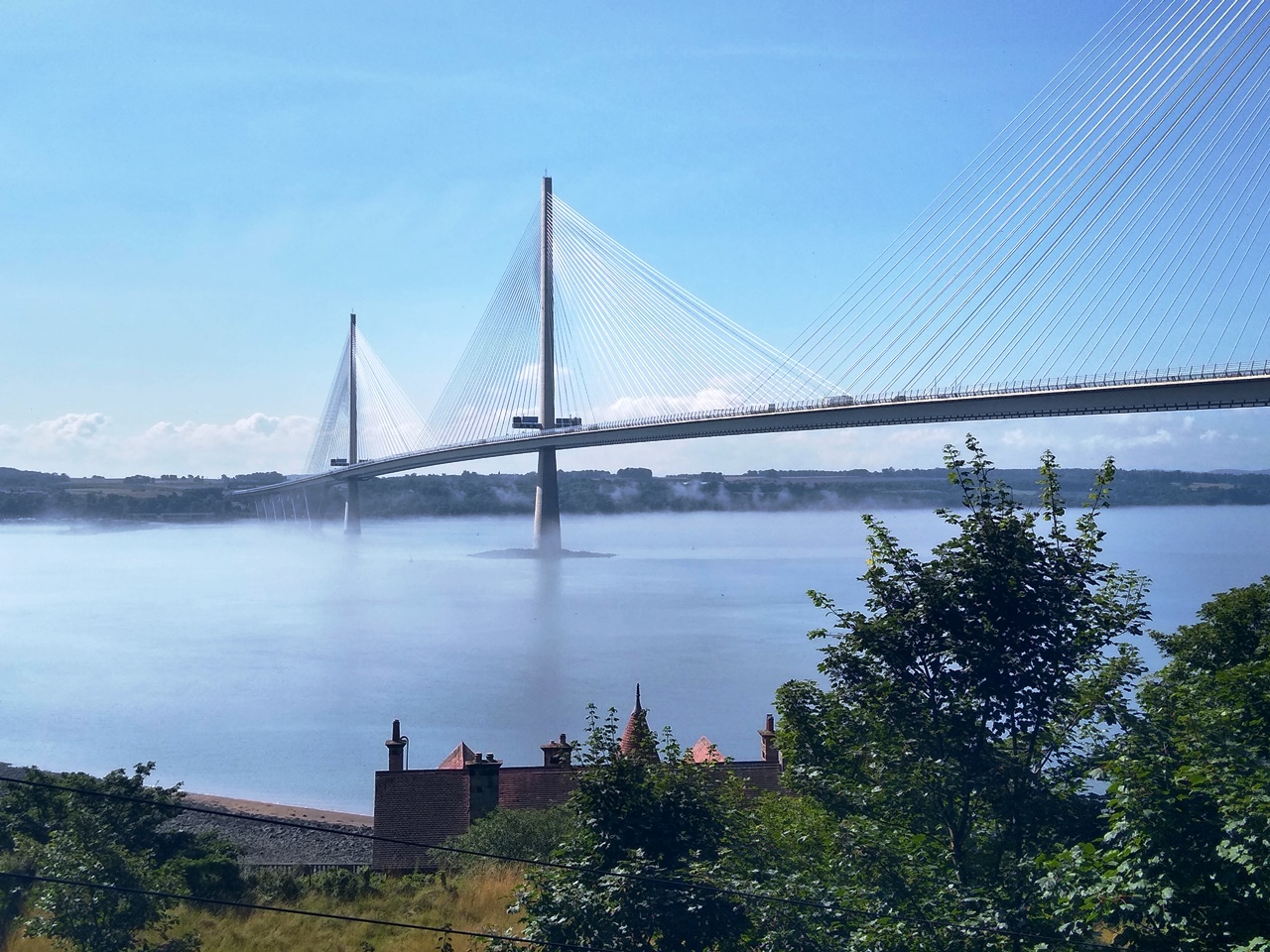
The newest bridge, the Queensferry Crossing, is the tallest and could be seen emerging from the mist as I followed the road past St Margaret’s Marsh and under the access road for the bridge gradually descending towards the village of North Queensferry. After passing underneath the older Forth Road Bridge I eventually reached the harbour that is the centre of the small community underneath the nineteenth century Forth Rail Bridge that is such an icon of Scotland. There, I had my lunch basking in the sunshine and in the sight of the two road bridges while above me trains rumbled across the Forth Bridge. When I tried to resume my walk along the trail I was immediately confronted with a closed path, so I had to find the diversion, which took me under the Forth Bridge and up a path to the original route that heads into Carlingnose Point Nature Reserve. Now I felt like I was on a proper coastal path as the terrain was stunning with wild scenery around me and a rough path underfoot that was an absolute delight and the only disappointment was that I wasn’t getting a good view of the Forth Bridge as the coast turned away. The stunning terrain continued as I descended to the small bay of Port Laing, while the whitewashed houses of Dalgety Bay sparkled in the sunshine across Inverkeithing Bay.


Unfortunately the delightful, wild scenery soon came to a crashing end when I turned the point of the very Gaelic sounding Ard Alanish into inner bay where industry intruded with Cruick’s Quarry and Jamestown. More tedious road walking took me into Inverkeithing until eventually I came back out to the coast where there was a stunning view back towards the Forth Bridge as I walked along a delightful path past the remains of Prestonhill Quarry and into the town of Dalgety Bay. The trail skirts the edge of the town before plunging into fabulous woodland around Downing Point, but after that I was walking through tiresome residential areas that were not fun to walk through and seemed to go on for far too long. This trail is great when man doesn’t intrude, but there are far too many times where the trail passes through heavily developed land. Eventually I left the residential areas of Dalgety Bay behind and walked around the actual Dalgety Bay, which was a much nicer place to walk, even though the bay itself is out of bounds due to radioactive waste that is currently being removed. In much more relaxing surroundings, I walked around the bay until I reached the ruins of St Bridget’s Kirk where I finally left the coast to head inland, then right along a wide, but pleasant track that eventually brought me through a golf course into the village of Aberdour.


I covered seventeen miles along the Fife Coastal Path on this walk and Aberdour seemed like the best point to stop and catch a bus back to Leven. It was great to tread out the miles on this walk, especially with a light rucksack after my agonising walk of the previous day. There was an excessive amount of industry in the Firth of Forth that intruded on the walk, but the trail was at its best when it was beside the coast, since it is supposed to be a coastal path. However, for large sections of this stage of the trail it was not within sight of the coast, especially during the first half of the walk, but overall it was much better than the first day and the highlight was the three bridges across the Firth of Forth, but even beyond there the trail was often marred by man’s destructive intervention. Despite the beauty of the Queensferry Crossing, man never improves the landscape and it is only when nature is given free reign that beauty can truly develop.