Showing posts with label Sutherland. Show all posts

Thursday, 12 September 2024

Falls of Kirkaig and the Bone Caves of Inchnadamph

Tuesday 4th June 2024

I was awoken at the start of this day by the realisation that my tent had collapsed due to the strong winds, a pole had snapped, which was not a great way to start the day. I lay there for a while dejectedly thinking about how this holiday had not gone to plan until eventually I got up and slowly removed everything from my tent. Fortunately I was not planning on camping for the rest of the holiday so I didn’t need to worry about repairing it. After eating my breakfast I took the opportunity to explore Achmelvich Beach once again, which I had been doing every evening since getting there and I never tired of the complex, craggy scenery and the sandy beach. The previous evening I had set off along the coast along a waymarked path that took me over Gleannan an Fheadair and past Alltan’ abradhan until I reached an old corn mill in a deserted little valley. An information board described how this used to work though there was little now to see of the mill. A small bay, Port Alltan na Bradhan, lay nearby but as it was getting late I soon turned around and headed back to the campsite. This is a fabulous area that I previously visited in 2010 so I enjoyed the opportunity to return even though the weather was not kind to me, just as in 2010, with strong winds that felt bitterly cold for the time of year and robbed me of my enthusiasm for climbing mountains. The forecast for this day was even for snow at the tops of the high mountains so I had to look for low level walks on what was sadly my last day in the historic county of Sutherland.


When I finally left Achmelvich Beach, I passed through Lochinver and along the narrow, single-track road through Strathan past Inverkirkaig to a small car park on the southern edge of Sutherland where a path follows the northern bank of the River Kirkaig. This was a great route which helped to calm my troubled mind and afforded me with good views into the deep recesses of the valley where the river was soon enclosed by woodland. The pleasant walk kept me high above the valley while mountains began to appear on the horizon, from my right were Stac Pollaidh, Cùl Beag, Cùl Mor round to Suilven on my left. They were all clear of cloud for the first time in several days which made me feel that an ascent of one of them must be possible if not for the strong, cold wind. At a cairn, I ignored the fainter path that heads towards Suilven and took the clear path that brought me steeply down to the river and soon provided me with views of the Falls of Kirkaig, which looked magnificent even before the descending steeply while the sun came out at just the right time to illuminate the spectacle. At the bottom of the precipitous path the full length of the falls revealed themselves and I was able to bask in the amazing sight until eventually I tore myself away and climbed back up the treacherously steep path and along the same route I’d taken out.
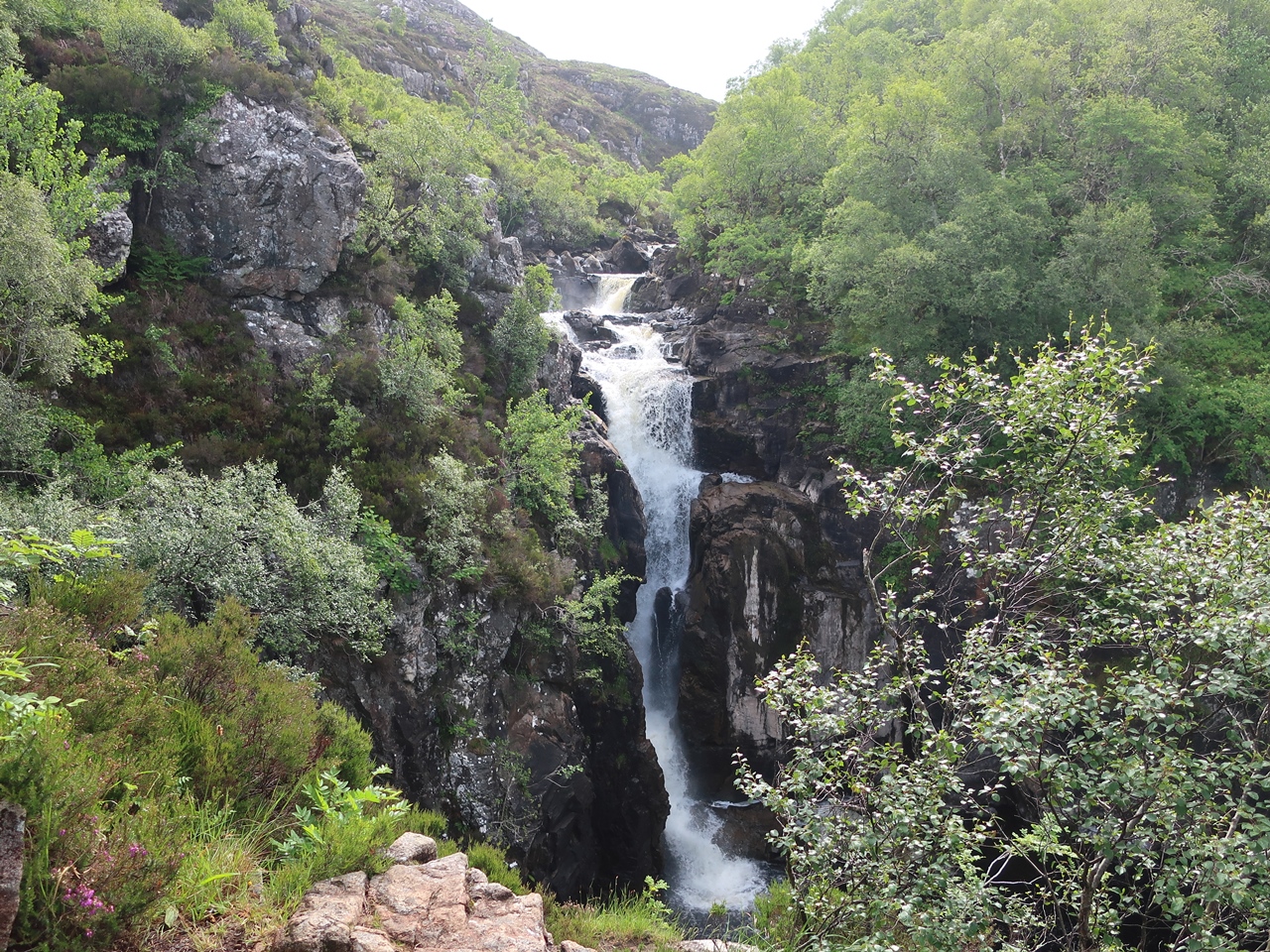

After my difficult start to the day, this walk did much to revive me, but it had only occupied a couple of hours and any thought of climbing a mountain was wiped out by the rain that welcomed me back to my car and followed me as I drove through Lochinver and out along the main road. I eventually stopped at the car park for the Bone Caves of Inchnadamph where it was still raining so I had an early lunch before donning my waterproofs and setting off towards the caves. However, the rain stopped almost immediately to reveal gorgeous sunshine on a wonderful walk past a small waterfall and up to Fuaran Allt nan Uamh where the water for the river seemed to bubble out of the ground as if by magic and the bed of the stream further up the valley was dry: I was in limestone country. I followed the path across the stream and steeply up the bank to reach the caves where the bones of arctic fox, lynx and wolf have previously been found. I had a fascinating time exploring the various caves and gazing out of them until eventually I continued along the path that crosses the steep slopes below Creag nan Uamh before reaching a stream and descending to the dry river bed of the Allt nan Uamh where I slowly made my way back down to the car park. Inevitably it started to rain when I reached my car but I really enjoyed this short walk up to the bone caves which was helped by the timely appearance of the sun.


The rain was heavy but brief and with the skies clearing again I looked longingly on the surrounding mountains. At one time I had planned to climb Canisp on this holiday which is a mountain that lies west of the bone caves and I looked eagerly at it now. Despite knowing that Canisp is a big mountain and an ascent would take me a long time, I could not resist setting off along a boggy path that would take me towards the broad eastern slopes, but impenetrable bogs convinced me of the foolishness of my endeavour and soon I turned back. While driving towards Ullapool I was frustrated at the sight of fabulous mountains that I couldn’t climb but when I reached the Knockan Crag National Nature Reserve I pulled into the car park. I hadn’t planned on walking around this reserve, partly because it isn’t in Sutherland, it is just across the border, but also because I visited Knockan Crag in 2010. This area played a significant role in the development of our understanding of geology, but that wasn’t what motivated me to stop. I just wanted to do a walk and if I couldn’t climb a mountain then I would try to get a view of them instead. The awesome Cùl Mor was nearby while its lesser partner, Cùl Beag could also be seen, however it wasn’t long before a heavy shower overwhelmed me so I crouched behind the northern viewpoint and waited while hail and rain fell.


When it eventually began to ease I got up and headed into the rain along the path that runs along the top of the crag and by the time I returned to the car park it had stopped raining and the sun was out again. This day was a hotchpot of different walks that sadly ended my time in Sutherland. I was astounded by the sight of the tremendous mountains in the historic county but frustrated that I was unable to climb any of them. Instead I was forced to do small walks that I would otherwise never have done and surprisingly I found that I really enjoyed them.

Thursday, 5 September 2024

River Inver and Glencanisp

Monday 3rd June 2024

With strong to gale force winds over the mountains in West Sutherland on this day it wasn’t practical for me to be walking high so I decided I would keep low and I was surprisingly excited in anticipation of the walk that I had planned. Eagerly, I set off from Achmelvich Beach along the narrow road with my first objective being to get to Lochinver and for that I needed to get around Loch Roe which blocked my way. After a mile along the road I turned right onto a driveway that soon became a stony track and the walk only really became interesting after passing Ardroe Croft. The path now passed through gorgeous moorland sprinkled with many outcrops and decorated with spotted-orchids, but the early morning sunshine beside the coast was now gone so that when the view over Loch Inver appeared before me the iconic Suilven was hiding its head inside clouds. On reaching the bridge over the River Inver I was reminded of why I was not going up a mountain as it was very windy so I soon joined an anglers’ path that follows the river upstream past spectacular rapids over a rock-filled bed in a tree lined landscape that was a beautiful and soothing place to walk.


A fabulous path slowly took me through the gorgeous landscape while several access points for the anglers dropped to the side of the river but I was happy to follow the path that took me past a series of pools until eventually I emerged from the wood and reached the point where the path turns to the right towards Glencanisp. This would have soon returned me back to Lochinver and ended my walk far too quickly so I kept beside the River Inver even though the path was now rough and tricky to follow especially when passing steep ground. Once beyond I was in an area that appeared to have suffered from an extensive fire in recent years and, though the ground plants had now recovered, the larger woody plants appeared lifeless and burnt. Eventually I found a footbridge that took me over the River Inver onto a road and finally onto the main road into Lochinver where I had a mile or two of walking that was rather unpleasant as the passing cars were travelling very fast, but there were two places where an old section of the road, around small hills, provided me with the opportunity to get away from the speeding cars until eventually I reached Little Assynt. There a great path took me through a wonderful landscape of mixed woodland and moorland decorated with many wild flowers including bluebells, stitchworts and spotted-orchids, and the sun came out to accompany me through this delight.


Eventually I reached a viewpoint between Loch Tòrr an Lochain and Loch na h-Innse Fraoich that provided me with a view of the surrounding mountains which still had their heads in clouds and were cloaked in grey shadow. Not far away from me was Quinag which I had started to climb the day before while Suilven was in the distance to the south, but I was especially taken by my immediate surroundings which were immensely beautiful in their setting of rock, tree and lake. After eating my lunch I set off back along the path into the strong cold wind and on reaching the main road I took to a path marked Suileag which I soon found was not as clear as others I had been following this day even losing the path after passing through a gate. When I realised I had to retrace my steps back to the gate and try to follow the path exactly as marked on my map even though there was no trace of it on the ground. Eventually a sort of path materialised though it was faint and tough to follow through a complex terrain slowly heading south, but while climbing between two low hills I realised that the path at one time had been well-engineered as it zigzagged through the terrain. There was no sign of this across the moor, but once I realised this I began to see other traces of what had once been a good path but was now rarely used.


Suilven now dominated the view ahead of me even though it was shrouded in grey clouds as I made my way along the faint but now clear path down the hill, past a string of lochs and up another hill to where Suileag was hiding just beyond. This is a bothy where one can spend the night though facilities including running water do not exist. A work party was there taking an afternoon break so I had a chat with them before taking the much clearer path through Glencanisp where I was spoilt by the views ahead of me towards Loch Druim Suardalain or back towards the imposing bulk of Suilven. I previously came this way in 2010, but the weather on that day had been excellent while on this day the sunshine I had enjoyed at Little Assynt had been short-lived, though there were occasional glimpses to remind me of what could have been. Once I was back in Lochinver I walked around the harbour to the River Inver and retraced my steps back over Ardroe at the end of an amazing walk. The weather actually helped with this walk as, although it was marred by the strong winds, the occasional sunshine and warmth made it an enjoyable walk especially beside the River Inver and then later while passing Suilven which recalled my ascent in 2010. This walk shows you don’t need to go up a mountain to have a good walk.

Thursday, 29 August 2024

The Ben Strome Stalkers’ Track

Sunday 2nd June 2024

After good, but windy weather on the day before this walk I was disappointed to see on the forecast that the weather for this day was going to be poor with rain coming in late afternoon and the wind strengthening. I was hopeful that this would give me a chance to climb a mountain before the weather deteriorated so I drove to the foot of Quinag, but it was raining even before I reached the car park. Undeterred, I put my waterproofs on and set off along the good path that leads towards the mountain, but I soon had doubts whether this was worth the effort, though the excellent path, built by the John Muir Trust, spurred me on through the wind and rain. Eventually the path petered out near Lochan Bealach Cornaidh, though only my GPS location told me the lake was nearby as I couldn’t see it, and so finally I decided to turn back. I didn’t feel it was worth walking in this weather. Being at the top of a mountain is a fabulous feeling, mainly when the weather is good and you have views in all directions, but not in the wind and rain. It is just not worth the effort. However, I passed many people while coming back to the car who were attempting to climb the mountain and were seemingly not deterred by the weather. I don’t know whether any of them actually reached the summit of Quinag, but I didn’t, though I enjoyed walking along the excellent path while it lasted.

When back in my car I had a look for something else to do and soon noticed in the local Hallewell pocket guidebook a walk entitled “The Ben Strome Stalkers’ Track” that immediately appealed to me. I drove down the hill, over the Kylesku Bridge and found that here it was hardly raining or windy. I set off along a path that left the road to the old slipway and climbed the hillside with views down to the loch and the narrow channel through to Loch a’ Chairn Bhàin. The previous evening I had driven through here from the foot of Foinaven in much better weather and been astounded by the stupendous scenery of this fjord-like sea inlet, but now the weather was so poor I could hardly see the far side of the water, let alone the steep mountain slopes. A visit to this area demands clear views, even if you are on a drive such as the NC500. I previously drove through Kylesku in 2010 and the weather then was just as poor as now so I hadn’t appreciated how spectacular the scenery is and again now I could not see what had so overwhelmed me the day before. While I could I took pictures of the murky scene until all too soon I disappeared into the clouds and had to resolve myself with the path ahead which weaved a course across the slopes of Ben Strome while it began to rain heavily.


Time seemed to drag while on that path. After what felt like ages I would look at my watch and be astonished that only a couple of minutes had passed since I’d last looked. Eventually, after a seemingly long walk through the unchanging scenery, I reached the cairn that marks the junction where a path turns back down the hill. At one time I had planned to do the Sutherland Trail which passes through here and I was disappointed that I was not doing it, though I would have needed good weather to appreciate the scenery and it would not have been fun to do a long distance trail in this poor weather. With the rain easing slightly, though not the wind, I made my way down the hill to the shore of Loch an Leathaid Bhuain, past a fisherman’s hut and continued down beside the Maldie Burn where various waterfalls were enriched by the rainfall. Below the clouds the views seemed brighter than when I had started the walk with Loch Glendhu and the mouth of Loch Glencoul offering a hint of the wild beauty of this area. With the strong winds ever present I made my way down to the shore of the loch and had an enjoyable stroll back to my car at Kylestrome.


With the afternoon still young, I wondered what to do next and considered doing a short walk around Loch na Gainmhich, but the heavy rain and strong winds at the top of the pass soon changed my mind and I drove past until I eventually returned to my campsite at Achmelvich Beach. It wasn’t raining there so I had a walk around the rocks and along the beach while taking some pictures of the swirling seas driven by the strong seas. The weather ruined most of the walking this day and it is notable that the most enjoyable part of the day was when I had some sort of a view and it wasn’t raining.

Thursday, 8 August 2024

Foinaven

Saturday 1st June 2024

I spent most of my time on this holiday in the historic county of Sutherland, which I had previously visited just once back in 2010 when poor weather and bad planning had meant there were a number of hills that I failed to climb so I was hoping to do those hills now. However, with the weather as it has been this year in Britain I was not very hopeful, but the forecast for this day was surprisingly good with the Mountain Weather Information Service even using the word glorious. It didn’t seem that good, but at least it was dry with little wind as I made my way across the county through mesmerising, sparsely populated scenery along the shores of Loch Shin, Loch Merkland and Loch More until I reached a small car park just before Loch Stack. For a long time my plan for this holiday had been to do the long distance walk of the Sutherland Trail devised by Cameron McNeish. This starts in the west coast village of Lochinver and crosses Sutherland past many of the mountains in the area to reach the north coast at Tongue. I had been eager to do this trail and to climb some of the mountains on the way, but after my experiences at Easter camping in Dartmoor I realised that I don’t really like camping and with Sutherland being very sparsely populated I wouldn’t be able to restock with food between Lochinver and Tongue. So I reformulated this holiday by taking my car which prevented me from doing the Sutherland Trail, but still let me climb those mountains that the trail passes and I was starting with Foinaven.

The scenery on the drive had been stunning and now as I made my way along a wide track away from the car park on the actual route of the Sutherland Trail I was struck by the sheer beauty of the mountains in this area that are covered in rock falling precipitously to the shores of the numerous lochs that litter the landscape. The conical peak of Ben Stack dominated the scene but soon it was the craggy of slopes of Arkle, on the other side of Loch Stack, that drew my eye before starting to slowly to climb the track that heads into the mountains beside Allt Horn. The weather was not as glorious as promised with overcast skies spoiling the view although eventually the clouds thinned to reveal blue skies, except above the mountain tops which held onto a heavy covering of cloud. The awesome mountain scenery continued as I slowly climbed the track and eventually I reached the col between Arkle and Foinaven and onward I climbed until I reached Bealach Horn where I finally came off the path at a small pile of stones to venture across the pathless slopes towards Foinaven. Unfortunately, by now I was being attacked by a strong cold wind that made this relentless climb extremely difficult and frustrating, especially when the weather was good in all other regards and amongst spectacular scenery. A strong cold wind can ruin a walk as effectively, or even more so, than rain or low clouds.


I crossed bands of rock and grass to traverse Bealach Horn before climbing unending slopes into the strong cold wind while Arkle continued to dominate the view with its exuberance of rock that made me wish I had forsaken Foinaven to climb the smaller mountain. The summit of Foinaven was hidden behind intermediate hills but still I kept going, but as time advanced and my goal seemed always far away I began to doubt whether I would actually reach the summit. Eventually, at the top of An t-Sàil Mhòr, the summit ridge of Foinaven came into view and beyond I made my way against the strong winds across the col to an unnamed 808 metre top where I finally had a clear view of the narrow ridge that extends past a prominent pinnacle, over the unnamed top above A’ Chèir Ghorm before finally, a long way away, rises to the highest point on Foinavon. It was obvious that it would take me a very long time to get to the summit along that ridge and with my only return of route being back the way I’d come then, at my present rate, it would be very late in the day before I finally returned to my car. With this in mind and the strong, cold winds that continued to batter me I decided to turn back and be content with getting as far as I had.


With the wind now at my back I was able to enjoy the return and admire the gorgeous, ground-hugging, purple flowers that covered the mountain slopes and the fabulous mountain scenery all around me that was making the climb worth the effort, even though I didn’t actually reach the summit of the mountain. I bypassed the top of An t-Sàil Mhòr slowly making my way down the rocky ridge, still being battered by the wind that had ruined the walk. Rather than head back to Bealach Horn I kept to the top of the ridge which gradually took me down to the col with Arkle while I wondered what could have been. I had originally wanted to do both Arkle and Foinaven, but with hindsight Foinaven is not practical from where I’d started and if I’d set my sights on Arkle instead, which is smaller both in height and breadth, then I would have easily been able to reach the summit, so perhaps next time, whenever that may be. I enjoyed the walk amongst stunning mountain scenery and the slow descent, especially when out of the wind, that let me catch my breath after an exhausting and exhilarating walk. 

Thursday, 1 August 2024

Around Lairg

Friday 31st May 2024

With the improving weather I had on the day before this walk, I felt that it would be a shame not to climb a mountain this day, so after a discussion with the owner of the campsite I was staying at I decided to head up Ben Klibreck, the closest Munro and the only one in East Sutherland. I woke to sunshine and eagerly set off north along the narrow A836 road, but when I reached the foot of the mountain I found that clouds had already covered the top and unless they cleared I would not have a view, and apparently the view is the best thing about that mountain. I had difficulty finding a parking space on the single-track road, so after driving up and down I eventually parked at the entrance to the Creag Riabhach Wind Farm from where I needed to walk for a mile along the road before I reached the path that branches off across the River Vagastie and beside the Fèith Bad an Loch stream along a path that was very boggy and not at all reliable. With Ben Klibreck holding onto the cloud ahead of me and the weather deteriorating, I was beginning to question the wisdom of continuing along this difficult, tiring path that had become little more than a bog-hop. I walk purely for pleasure and I was certainly not going to climb Ben Klibreck simply to tick off a mountain on a list. I enjoy being at the top of a mountain but mainly only when there is a view and the poor, overcast weather that I had now was not inspiring me to keep going. Near the outflow of Loch Bad an Loch I stopped and considered my route ahead across largely pathless, boggy, heather moorland and eventually I decided to turn back.


I most appreciate walking on good paths and this attempt up Ben Klibreck seemed like too much hard work, and ultimately a waste of effort. After returning to my car I drove back along the single-track road to the village of Lairg where I had a look around, including in the tiny Church Hill Woodland which overlooks the reservoir, Little Loch Shin, that lies in the centre of the village. Eventually I made my way to the Ferrycroft Visitor Centre, where I read up on the history of the area before setting off into Ferry Community Woodland. My original plans for this day were meagre and ill-defined and started with this short walk that took me through a young wood on the shore of the loch and all too soon brought me to the dam that separates Little Loch Shin from its much bigger neighbour, Loch Shin. Back at the visitor centre I started the second leg which took me up Ord Hill where I had panoramic views of the surrounding countryside that included the two lochs and south down Achany Glen. The weather was still not good but I enjoyed the vantage point from this modest hill where prehistoric remains of chambered cairns and hut circles littered the slopes. None of the hills in this area are particularly high, it’s not a very dramatic landscape being more subdued, but I was still pleasant to walk around and explore this quiet part of Scotland.

As I was coming down from Ord Hill rain attempted to fall and these brief showers continued throughout the afternoon, perhaps confirming that this was not to be a great day for walking. A local guidebook had revealed to me that there was something interesting to see down Achany Glen, so I drove south through the valley to Shin Falls where a large car park was provided opposite a path that descends steeply to the River Shin and a waterfall, singular. I was rather disappointed by Shin Falls as there wasn’t much to it and the viewpoint simply brings you to a place where you can see salmon leaping, but it did not provide me with a good picture of the falls. The path didn’t go anywhere else so I had to climb back up to the road where I turned onto a waymarked path between the road and river that provided me with more interest. Blue ringed posts marked the route that soon crossed the road and returned to the car park where I now started to follow green ringed posts that led me up the hill through Shin Forest. I contemplated extending the walk to the top of the hill behind the wood, but since I had not been sleeping well I was very tired, so I just kept to the green ringed posts which rewarded me with views across Achany Glen before descending back down through the wood to the car park.


This was an odd day and disappointing since when I got up I thought the weather was going to be good and I’d be able to walk up a mountain. Instead the weather soon deteriorated and I was left to do several short walks in the area, which were nevertheless relaxing and enjoyable in a way, but not very satisfying.

Thursday, 25 July 2024

Ben Bhraggie, Big Burn and Dunrobin Castle

Thursday 30th May 2024

When I drove up to Scotland in 2010 I took a great tour around the North Highlands echoing parts of the popular NC500 long before it was launched, but I have not been back to the historic county of Sutherland since. There were mountains in the area that I had not climbed on that occasion, partly because of poor planning and also because of bad weather, so I wanted to return and therefore my principle goal for this holiday was to return to Sutherland. To start, I left the Cairngorm Mountains and drove through the city of Inverness along the A9 up the east coast into the historic county of Sutherland and eventually stopped in the town of Golspie. I did not do any walking in this part of the county in 2010, preferring the more mountainous west coast, so this time I thought I’d start with a walk in this south eastern corner. Overlooking the town is a monument to the first Duke of Sutherland who is quite a controversial character for his part in the Highland Clearances when thousands of people were evicted from their homes to make way for sheep farming, but I just thought it would be good to walk up the hill the monument sits on. In glorious sunshine I set off up the hill, initially on a road, and as I climbed the views over Golspie and out to sea were increasingly spectacular, especially after what has seemed like months of rain this year. It was great to be finally getting great weather, but as I approached the monument I was hit by strong winds coming off the hills that made the walking considerably less enjoyable.


The views were stunning but it was only while standing on the seaward side of the monument that I was really able to appreciate them as when I moved inland along a clear path towards the top of Ben Bhraggie I was hit by strong winds. This path soon circled around the northern slopes and descended back towards the sea and I was more than happy to be out of the wind as I re-entered Ben Bhraggie Wood. The path led me past the conifers to a signpost that showed the route back to Golspie, but I had other plans. I had found a walk on the OS Maps app called ‘Country Walking: Ben Bhraggie, Highland’, which now directed me into the glen of Golspie Burn where a walk described as Golspie’s hidden gem, known as the Big Burn Walk, took me through a delightful wooded gorge. At a road I crossed the burn and took a path into the wood beside the stream where waterfalls were the star attraction, though I was also attracted to the woodland flowers that could be seen at this time of the year scattered throughout that included bluebells and later wild garlic. The well-constructed path took me safely through the gorge and eventually brought me to the foot of a tall waterfall that was not as impressive to me as the deep, cavern-like gorge surrounding the falls that had been created by the slowly eroding action of the waterfall. The fabulous path continued through the impressive gorge where woodland flowers decorated the rugged scenery, notably wild garlic, but all too soon my delight came to an end at the A9 trunk road.


On the other side of the road I followed a path through woodland abundantly decorated with flowers, though sadly now mostly gone to seed, not far from the beach as I followed the coast through to Dunrobin Castle. This is the seat of the Duke of Sutherland but I had no interest in going inside so I quickly made my way past the tourists, continuing through the woodland and soon I was out onto grassland than ran alongside the shingly beach for a relatively tedious walk beside the coast until I reached the ancient, circular, fortified dwelling called Carn Liath Broch. I have seen visited brochs and this one is less impressive than others I have seen, notably in the Outer Hebrides. As clouds began to envelop the skies I made my way back along the coast over the grassland and on re-entering the woodland around Dunrobin Castle I kept to the coast passing below the castle and formal gardens through wildflower-rich meadows. While the sun came out again, the monument on Ben Bhraggie could be seen ahead standing over Golspie and I re-entered the town at the end of a varied walk with three very different stages. From the wind-swept hilltop with extensive views to the fabulous gorge walk I finally ended with a coastal walk past Dunrobin Castle. After all the rain of this year, the sunshine on this walk was a welcome change and was the highlight of the walk.

Wednesday, 25 August 2010

Ben Loyal

Wednesday 9th June 2010 

After going up Ben Hope, the day before this walk, I drove to the village of Tongue, which was a stark contrast to the tourist-laden splendour of Durness. Tongue is a quiet, secluded village beside the picturesque sea loch of Kyle of Tongue. I asked in the local shop what there was to see in the area and I got the reply that there wasn’t much. I took a walk up to a nearby tower called Caisteal Bharraich, which has dramatic views across the loch, as well as views inland to the multiple topped mountain of Ben Loyal, which is affectionately referred to as the Queen of the Scottish Highlands. The next day, I had another cold and cloudy walk ahead of me as I set off through Ribigill Farm and across the vast moorland of Bad Salach to a ford. Once across the river I climbed up a boggy path beside the imposing mass of Ben Loyal. Slowly the first top of Ben Loyal passed by me and I began to be concerned that the path I was on was going through the pass of Bealach Clais nan Ceap and not up the mountain. Quickly I turned around and began to slowly climb the steep hillside to my right. This was a really tough climb, but it surely would have been a lot steeper if I had taken Ralph Storer’s route straight up the face of the mountain. Eventually, after a lot of effort, I managed to reach the rocks at the top of Sgòr Chaonasaid. It was very windy up there, but nevertheless I clambered onto the top of the end crag from where I had great views along the length of the Kyle of Tongue and behind to the summit of Ben Loyal across a grassy plain. Climbing back down I bypassed all the other rocky tops, the most notable being the second top, Sgòr a’ Bhatain, and headed straight for the summit of Ben Loyal, An Caisteal (The Castle). The summit is well named as it is a huge circle of rock, impregnable except at one point, surrounded by the towers of the other tops of Ben Loyal. After climbing onto the huge rock that is the summit I found the trig point that marks the summit of the Corbett (Ben Loyal is not a Munro as it is less than three thousand feet high, in fact it almost isn’t a Corbett as it is only just above two and a half thousand feet). Climbing back down and circling round to the south I found shelter from the wind and had my lunch.

After eating I set off across the vast grassy saddle to the next top, Beinn Bheag. I was rather euphoric during that crossing, sheltered from the wind, wrapped up against the cold, and striding out through the clouds across the top of a mountain that stands far from any others. A western ridge branches off from the top of Beinn Bheag, and this was my descent route, which I immediately took rather than visiting the fifth and final top of Ben Loyal, the grassy dome of Carn an Tionail. I climbed down the steep grass slope onto the ridge and passed over the multiple tops of Sgòr a Chleirch before reaching the end of the ridge. There I dropped steeply off the end, clambering carefully down to the mouth of Calbhach Coire. Following the stream I dropped down through a delightful birch wood descending steeply to the moorland floor. 

I now had a couple of miles of walking across the vast moorland until I crossed the ford again and returned to Ribigill Farm. Once again there was another long walk in and out of a mountain in Scotland, which amazes me how often that happens. I couldn’t help thinking what I would have done if I hadn’t had the car. Although there is a Youth Hostel near Tongue I would have had to walk a couple of miles into the village and then another mile the other side of the village to Ribigill before I’d even started the walk I did this day. And then of course I would have had to repeat it at the end of the day, which is an all too familiar story. Despite the poor weather, this was an enjoyable walk over an interesting mountain, I just wish I could have found an easier way up.

Thursday, 19 August 2010

Ben Hope

Tuesday 8th June 2010 

After my previous walk I drove up a narrow twisting road to the north coast of Scotland leaving the delights of Assynt behind. The area around Lochinver is an absolute wonder and I was really disappointed to be leaving. I had originally planned on spending four nights in the area, which would have given me a chance to walk up Quinag and Foinaven, but in bad weather I left these behind in favour of the north-western-most village in mainland Britain: Durness. The next day I behaved as a tourist sampling the delights of Durness including Cape Wrath (the north-western point), enjoying the sunshine beside the coast while the mountains inland were covered in rain and low cloud. The area around Durness is a treasure trove with a wide variety of wonders that includes vast caves, flower-covered moors and fabulous beaches. I had a great day in Durness, but the day after I was back in my walking boots for a walk up the most northerly Munro in Scotland: Ben Hope. I parked alongside other cars at the foot of the main path up Ben Hope and followed others up the path beside a stream. When I had started it looked like the good weather was back so I was slapping on sun cream and stripping down, but unfortunately it didn’t last. When the walkers ahead of me left the stream behind I stayed beside it and climbed a shelf below the high western cliffs of Ben Hope. Unfortunately I carried on climbing when I should have stayed beside the stream so by the time the stream reached Dubh-loch na Beinne I was high above the lake on a steep hillside. My difficulty in continuing to walk along that steep gradient eventually prompted me to try and climb onto the top of the ridge. After a lot of very steep climbing I eventually reached the top of the ridge where I collapsed onto the ground and had my lunch, while rain started to fall. The point where I’d joined the ridge was at about the 700 metre contour so I was already a good way up the ridge having missed out on the delights lower down. Resuming the walk I climbed up the ridge through clouds to the foot of a bad step where I suddenly had stunning views below the clouds of a small loch in a corrie and Loch na Seilg beyond. The bad step is a serious scramble and far beyond my capabilities so I simply side-stepped it by climbing up a nearby gully, which was rather difficult itself in the wet weather, though not unenjoyable. Ultimately I reached the top of the crag face where a short walk brought me to the summit. Ben Hope should have stunning views as there are no other Munros for miles around, but the top was covered in clouds, which spoiled my view. On my descent, once I was below the clouds I was still sufficiently high enough to have some quite good views up the deserted Strath More. My descent was a straightforward walk along the regular, tourist route down a steep, wide, stony hillside and a muddy path back down to the road. 

I wasn't until I was on the ridge that I enjoyed this walk, but before then I was cursing Ralph Storer, and especially myself. This walk would have been a lot more enjoyable if I’d followed Ralph Storer’s instructions to “continue northwards beside the main stream onto the shelf holding Dubh-loch na Beinne, and keep going until a way can be made up onto the north ridge near Loch Seilg at its far end.” How easier could it have been explained? So why did I try to get as high as possible as early as possible? It is amazing how often I don’t follow the plain instructions I’ve been given, probably because at the time I think there is a better way. There are many times I’ve got myself into trouble and cursed Ralph Storer (or whoever) and most of the time it’s not been their fault. You’d think I’d learn. The north ridge of Ben Hope is fabulous even if the best bit is the area around the bad step. As the most northerly Munro it’s a good, easy climb, so long as you take the right route.

Thursday, 12 August 2010

Ben More Assynt

Sunday 6th June 2010 

My luck with the weather ended with this walk as it turned bad, subjecting me to rain and low cloud throughout much of the walk. I was walking up Ben More Assynt, the highest mountain in the Assynt area, which was a welcome change from the sandstone mountains that I had been walking up throughout almost all the previous week. I parked near the Inchnadamph Hotel and walked up Gleann Dubh and before long it started to rain. After contemplating giving up on the walk due to the terrible weather conditions, I decided to carry on since I was walking along an excellent path at the bottom of a pretty valley that has a delightful stream flowing through it. As I was walking along the valley I began to think about how every mountain in Scotland seems to have a long walk-in, usually across moorland or into a high corrie, which makes the distances walked much greater than in England or Wales. In the Lake District every mountain has a road at the bottom of it, which enables you to park at the foot of the mountain and walk straight up to the summit. Fortunately this walk was reasonably interesting as I passed caves that the river briefly disappears into and lots of colourful flowers beside the path. 

I followed the River Traligill upstream up a hillside, into the clouds and up to the top of a ridge where I turned right to climb along the stony ridge eventually reaching the cloud-covered summit of Conival where I had my lunch. With the rain finally stopping I climbed across an interesting, stony saddle, with steep drops on either side, up to the top of Ben More Assynt, the highest mountain in the area. In the mist it was difficult to identify which pile of rocks was the summit, with a group of guys ahead of me claiming that the south top was the summit. Eventually we decided that the summit of the Munro was opposite the saddle, which has a cairn, but it really could have been anywhere. I had entered the map co-ordinates for the summit into my GPS but I didn’t find it very reliable, or useful, for either Conival or Ben More Assynt. It’s strange how different GPS receivers can give differing co-ordinates for the same place. Ralph Storer recommends traversing the south ridge of Ben More Assynt, but this is an exposed, hard scramble that I didn't want to do in this weather (or indeed any weather!), so I turned around and retraced my steps. If Ben More Assynt had been a sandstone mountain then that difficult, narrow south ridge would have had an easier, bypassing route around the side. The Lewissian Gneiss of that ridge is some of the oldest rock in the world, so it isn’t easily eroded into paths and would be tricky to traverse, even in good weather. As I descended from Ben More Assynt the clouds unexpectedly started to part, revealing views of Dubh Loch Mór to my right and the wide waterlogged valley of Garbh Allt to my left. With a clear view of the ridge in front of me I bounced across and joyously climbed back up to the top of Conival, the third Munro that I had climbed up that day (also my first Munro of the day), and I was still in clouds. 

From the top of Conival I descended the stony ridge back to the col at the top of the path down into the valley. Soon after starting to drop back down into Gleann Dubh I was enveloped by thick clouds again and soon after that it started to rain. The brief good spell of weather that I had enjoyed on top of the two Munros proved to be short-lived as it continued to rain as I walked all the way back down the valley to my car. It was bizarre that the worst weather that I experienced during this walk was not at the top of the mountains but while walking along the valley below. I thoroughly enjoyed this walk, despite the rain, as these were honest, straight-forward mountains. They are not Torridonian sandstone monoliths, like the hills that I’d been climbing recently, but simple heaps of shattered quartzite stones. It was a refreshing change to walk up a simple mountain.

Thursday, 5 August 2010

Suilven

Saturday 5th June 2010 

Once again I had stunning weather for this holiday, and a stunning mountain to climb in lovely, warm weather, Suilven. This huge monolith of a mountain dominates the scene for miles around and is distinctively seen from the village of Lochinver. It may not be up to Munro status but in this area of few mountains it stands out and is in fact considered to be one of the best mountains in Scotland. Passing through Lochinver I parked at the end of the public road into Glencanisp. From there I walked along a fabulous track, past Glencanisp Lodge and through a gorgeous valley with gorse and bluebells lining the way before heather took over higher up. When I started the walk I couldn’t see Suilven as it was hidden behind the morning mist, but it wasn’t long before a huge scary looking shape started to appear through the clouds. As I drew alongside the enormous whale-back mountain the mist cleared sufficiently to reveal the awe-inspiring spectacle that I was going to be walking up. 

After crossing the river just before Loch na Gainimh I took a path that climbs across the moor past several small lochs to the foot of Suilven where I began to climb the steep slope. Eventually and after a lot of effort, I reached Bealach Mór, which is the lowest point on the ridge of Suilven. From there I climbed along the top of the ridge to the summit, Caisteal Liath, which is a surprisingly wide grassy plain. A little distance from the summit cairn is a flat slab of rock that sticks up into the air and makes a great backrest for the best seat in the world. From this vantage point I enjoyed extensive views across the whole area, looking out to sea and down on the wisps of cloud in the valley. I had my lunch while sitting on this throne-like seat and gazing across the amazing terrain of Sutherland where the mountains are few but the lochs are many. Returning to the saddle I climbed along the eastern ridge as far as I could go, though I only actually reached the first col. I could have gone further but I didn't want to. Like many of the mountains that I had encountered on this holiday, Suilven is a Torridonian Sandstone mountain with ridiculously steep sides and rock pinnacles on top. The eastern end of the mountain requires some rock climbing that I just wasn’t in favour of trying. These Torridon-esque mountains may be stunning to look at, but they terrified me. I never thought I had vertigo until this holiday. Fortunately, unlike Stac Pollaidh the previous day, the summit of this mountain is attainable by mere humans such as me. I can’t help comparing Suilven with Stac Polly, but it is easily the superior. In some ways it is like a bigger brother to Stac Polly; it’s certainly higher, but the rocks are not as shattered and it has only several tops rather than the innumerable tops of its lesser brother. Like all the Torridonian Sandstones there is a steep climb to the ridge but once there it isn’t too difficult to reach the summit so that even cowards like me can get there. After returning to Bealach Mor I reluctantly started to descend the steep hillside back down to the loch-scattered moor at the bottom. All that was now left for me to do was to walk slowly back down the valley in the warm weather past inviting lakes and moorland flowers in a plenty, with the might of Suilven itself behind me basking in the sunlight, like the prow of a battleship. This was a wonderful walk not just because of the fantastic mountain in the middle of the walk, but for the relaxing stroll through a picturesque valley where the view of Suilven dominates the scene. For any other walk the necessity of having a long walk in to the mountain would detract from the experience, but on this occasion and in this weather it adds to it. The path is a well-made stalkers' track that is always dry and passes through a valley that was a delightful place to walk through and always with the view of Suilven enticied me forward with every step. Back at Achmelvich Beach Youth Hostel the weather was great and the views across the bay were idyllic. This is such a wonderful area I was so gutted to be only staying there for two nights rather than my originally intended four nights. I spent that evening on the rocks overlooking the bay while reading a book and taking pictures of the stunning surroundings. My holiday would not get any better than this.